Types of Paper
The journal publishes high quality Original Research Articles, Short Communications and Reviews.
- Original Research Articles: are full length papers describing a comprehensive study. Original Research Articles should be between 2000-5000 words and include a maximum of 80 references with maximum five (5) figures.
-
Short Communications: are letter style papers which provide an overview of recent progress in a rapidly progressing field. Short Communications should be between 1500-2000 words and include a maximum of 50 references. No limits are placed on the number of figures, although authors are requested to use an appropriate number of figures.
-
Reviews Article: are full length papers describing the status of a high interest field, providing both an introduction to the new reader, and insight for the experienced researcher. Reviews should be between 3500-9000 words and include a maximum of 200 references. No limits are placed on the number of figures, although authors are requested to use an appropriate number of figures.
Peer Review Process
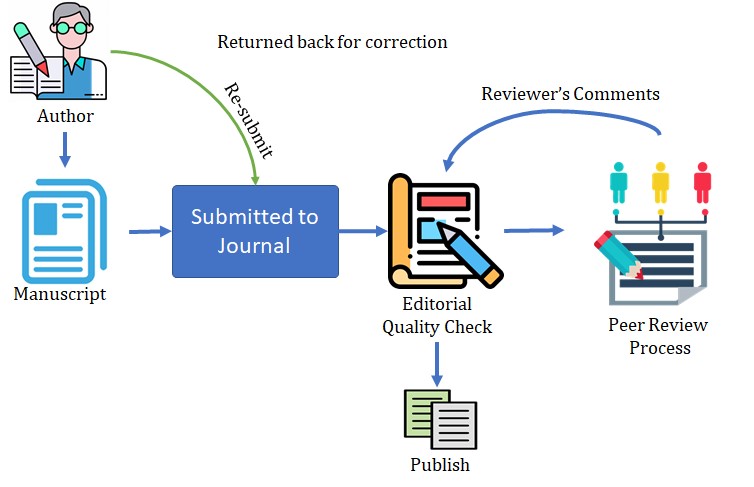
Probecell Science follows a double-blind peer-review process designed to maintain scientific accuracy, research quality, originality, and ethical integrity.
- Initial Editorial Screening: Every submission is screened by the Managing Editor for completeness, compliance with the journal’s author guidelines, relevance to the journal’s scope, and text similarity using Turnitin or an equivalent plagiarism-detection tool. The scientific suitability of the manuscript is assessed by the Editor-in-Chief or an appropriately designated editor. Manuscripts that do not meet the journal’s basic requirements may be rejected without external review.
- Double-Blind Peer Review: Manuscripts that pass the initial screening are evaluated by at least two independent expert peer reviewers with relevant subject expertise. The identities of the authors and reviewers are concealed from each other during the review process. Reviewers assess originality, scientific merit, methodological rigor, interpretation of findings, and ethical compliance. The final decision rests with the Editor-in-Chief or an appropriately designated editor.
- Decision Timelines: The journal aims to communicate an initial editorial decision within 1–2 weeks of manuscript submission. The actual timeframe may vary depending on reviewer availability, manuscript complexity, and the need for additional evaluation or revision. This timeframe is a target rather than a guarantee of completion of external peer review.
Submission Checklist
You can use the following list to carry out a final check of your submission before you send it to the journal. Please check the relevant section in this instruction manual for more details.
Ensure that the following items are present:
One author has been designated as the corresponding author with contact details:
• E-mail address
• Full postal address
All necessary files have been uploaded:
Manuscript:
• Title page (manuscript title, authors first name and last name, affiliations, email addresses, corresponding author name, address and contact details)
• Abstract
• Include keywords
• Introduction
• Literature/Related works/Theoretical background
• Materials and Methods
• Results
• Discussion
• Conclusion and Future Scope
• All figures (include relevant captions)
• All tables (including titles, description, footnotes)
• Ensure all figure and table citations in the text match the files provided
Further considerations
• Manuscript has been 'spell checked' and 'grammar checked'
• All references mentioned in the Reference List are cited in the text, and vice versa
• Permission has been obtained for use of copyrighted material from other sources (including the Internet)
• Relevant declarations of interest have been made
Article Processing Flow Chart
Plagiarism Policy
Probecell Science is committed to maintaining academic integrity, originality, and ethical standards in scholarly publishing. All manuscripts submitted to the journal must represent original work and appropriately acknowledge the ideas, findings, data, text, and contributions of other researchers. Submitted manuscripts may be screened using Turnitin or another suitable plagiarism-detection tool to identify text similarity, unattributed borrowing, duplicate publication, and potential instances of plagiarism. The journal evaluates similarity reports on a case-by-case basis, considering the nature, extent, location, and context of the identified similarities; no single similarity percentage is treated as conclusive evidence of plagiarism. Authors must ensure that all sources are properly cited, verbatim quotations are appropriately identified, and previously published material is used in accordance with applicable copyright and licensing requirements. Self-plagiarism, substantial reuse of an author's previously published text without appropriate disclosure, duplicate submission, redundant publication, and unauthorized reproduction of figures, tables, or other copyrighted material are not permitted. Manuscripts suspected of plagiarism or other publication-ethics violations may be returned for clarification, rejected, or subjected to further investigation, depending on the severity and circumstances of the case. Where concerns arise after publication, the journal may issue a correction, an expression of concern, or a retraction, as appropriate, following an assessment of the available evidence. Authors are responsible for the originality and integrity of their submissions, and all listed authors are expected to approve the submitted manuscript and ensure that relevant sources and contributions are properly acknowledged. Probecell Science handles suspected cases in accordance with recognized publication-ethics principles, including relevant guidance from the Committee on Publication Ethics (COPE).
Manuscript Formatting
Authors should submit the articles only
.docx (MS-WORD 2007 or newer version) format, no other format is accepted. If equations were used it should be converted by using MS Office equation editor and pasted as image at proper place. All equations should be grouped or may be prepared using equation editor software.
File size
No article should exceed the number of words specified in “Paper Type” section unless necessary, authors will be requested to substantiate the need if it exceeds the maximum number of words. The file size of the MS word format may not exceed 20 MB size.
Language
Language of the articles should be only in English, we are not processing articles in any other languages
Font type
Articles should be typed in single line spacing with "Times New Roman" font pattern.
Font Size
Paper Title: 16 point, Bold
Author/ Coauthors name: 13 points, Normal Affiliation/ Institute name: 9 points Abstract: 11 point, Line spacing:1.15
Heading or Title: 12 points and Bold (Small Letters, not capitalize the titles unnecessarily unless required, e.g. HPLC, HPTLC, UV, GC, TLC, SEM, TEM, etc.)
For subtitles: 12 points and Bold
Content of article: 11 points, Line spacing:1.15
Submission Order
The following order should be strictly followed while submitting the article:
Title page: (Page-1)
Title of article, authors' names, authors' institutional affiliations only and leave other spaces empty
On second page: (Page-2)
Start with abstract of about 200-400 words exactly conveying the content of the article, Keywords (at least 5 words)
On third page: (Page-3 onwards)
Main content text with all tables and figures aligned in their proper place (do not send tables and figures separately unless requested), List of symbols and Abbreviations, Acknowledgement, References (follow standard format)
Preparation of Manuscripts
Manuscripts should be submitted as per order: Title Page, name of author (s), Abstract, Key words, Introduction, Material and Methods, Results, Discussion, Acknowledgements (if necessary) and References. If the Result and Discussion sections are combined, then a Conclusion section should be added.
Title page
The first page should contain a concise and informative title, the names and addresses of the authors and contact details of the corresponding author (postal address, e-mail, and fax and telephone numbers).
Graphical Abstract
Prepare a relevant graphical abstract of your article. This is a single, concise, pictorial and visual summary of the main findings of the article. It could either be the concluding figure from the article or better still a figure that is specially designed for the purpose, which captures the content of the article for readers at a single glance.
Abstract
It should be about less than 250 words. Key words: A maximum of 5 key words must be given at the end of the Abstract
Introduction
This part should define the background and significance of the study by considering the relevant literature, particularly the most recent publications.
Material and Methods
Please provide concise but complete information about the material and the analytical, statistical and experimental procedures used. This part should be as clear as possible to enable other scientists to repeat the research presented.
Results
In this part, the same data/ information given in a table must not be repeated in a figure, or vice versa. It is not acceptable to repeat extensively the numerals from tables into text and give lengthy and unnecessary explanations of the Tables and Figures.
Discussion
This part must be written with reference to the tables and figures and by considering information from the literature. Statements made in the Introduction and Results sections should not be repeated here.
Conflict of Interest
Author(s) shall declared the conflict of interest Yes/ No before submission of manuscript for publication. The conflict of interest as mentioned in manuscript before references section or by the use of any free plagiarism checker, the author(s) shall provide the plagiarism report with submission of manuscript.
Ethical Compliance Standard
When reporting experiments on human subjects, authors should indicate whether the procedure follows were in accordance with the ethical standards of the responsible committee on human experimentation. Do not use patients' names, initials, or hospital numbers, especially in illustrative material. Papers including animal experiments or clinical trials must be conducted with approval by the local animal care or human subject committees, respectively.
Acknowledgements
If necessary, a brief Acknowledgements section may be included.
References
Author must follow the Elsevier-Vancouver (
https://open.mendeley.com/use-citation-style/elsevier-vancouver) citation style in the manuscript. You can also use the standard referencing tools like Mendeley (
https://www.mendeley.com/download-desktop-new/) to format your citations. Following are some sample reference formatting style:
Conference Article [1]
[1] Chandra TB, Verma K. Pneumonia Detection on Chest X-Ray Using Machine Learning Paradigm. In: Chaudhuri BB, and Nakagawa M, and Khanna P, and Kumar S, editors. Proc. Third Int. Conf. Comput. Vis. Image Process., Springer Singapore; 2020, p. 21–33. https://doi.org/10.1007/978-981-32-9088-4_3.
Journal Article [2]
[2] Chandra TB, Verma K, Singh BK, Jain D, Netam SS. Coronavirus disease (COVID-19) detection in Chest X-Ray images using majority voting based classifier ensemble. Expert Syst Appl 2021;165:113909. https://doi.org/10.1016/j.eswa.2020.113909.
Book Chapter [3]
[3] Taghipour M. Lateral Radiograph. Essent. Radiol. Rev., Springer International Publishing; 2019, p. 41–3. https://doi.org/10.1007/978-3-030-26044-6_10.
Book [4]
[4] Shalev-Shwartz S, Ben-David S. Understanding machine learning: From theory to algorithms. Cambridge university press; 2014.
Web contents [5,6]
[5] Global Tuberculosis Report 2019. World Heal Organ 2019. https://www.who.int/tb/publications/global_report/en/ (accessed March 13, 2020).
[6] Sprawls P. The Physical Principles of Medical Imaging, 2nd Ed. 2018. http://www.sprawls.org/ppmi2/NOISE/ (accessed July 25, 2018).
Figures
Photos or drawings must have a good contrast of dark and light. Legends of figures should be brief, but complete and self-explanatory so that the reader can easily understand the results presented in the figure. Figure legends should be attached to the figures. All figure number should be arranged orderly, the figures should not be supplied separately but pasted in the proper place. Figure number and title should be given below the figure, the content of the figure should be explained in the title of figure.
Tables
All tables should be numbered in order with grid lines. The table number should be properly given, large size tables should be split into two or more tables so that it can be accommodated within the page size. Table width and cell sizing should be even and all the content should be left side aligned. Number of the tables and title should be given above the tables and without any border, shading. Do not give on separate page. The table should with a brief but complete and self-explanatory caption so that the reader can easily understand the results presented in the table. Please do not duplicate material that is already presented in the figures.
Disclaimer
The editorial board of the Probecell Science (PCS) while make all possible efforts to ensure the accuracy of all the information in published articles, the authors are solely responsible for the accuracy of the information included in their manuscripts. Any views expressed in the publication are the views of the authors only, but not of the Probecell Science (PCS) . The onus is on the authors regarding their indulgence in plagiarism.
Copyright:
Authors retain copyright of their published work. By submitting a manuscript to Probecell Science, authors grant Probecell Press the non-exclusive right to publish, reproduce, distribute, and make the article publicly available in electronic and other formats. All articles published by Probecell Science are licensed under the Creative Commons Attribution 4.0 International License (CC BY 4.0). Under the CC BY 4.0 license, readers and other users may share, copy, redistribute, reproduce, adapt, remix, transform, and build upon the published material for any purpose, including commercial purposes, provided that appropriate credit is given to the original author(s), the source is cited, a link to the license is provided, and any changes made to the original material are indicated.